
Couple of days ago I saw this post on Linked in – and first it made me laugh – but then it got me thinking. It’s true…
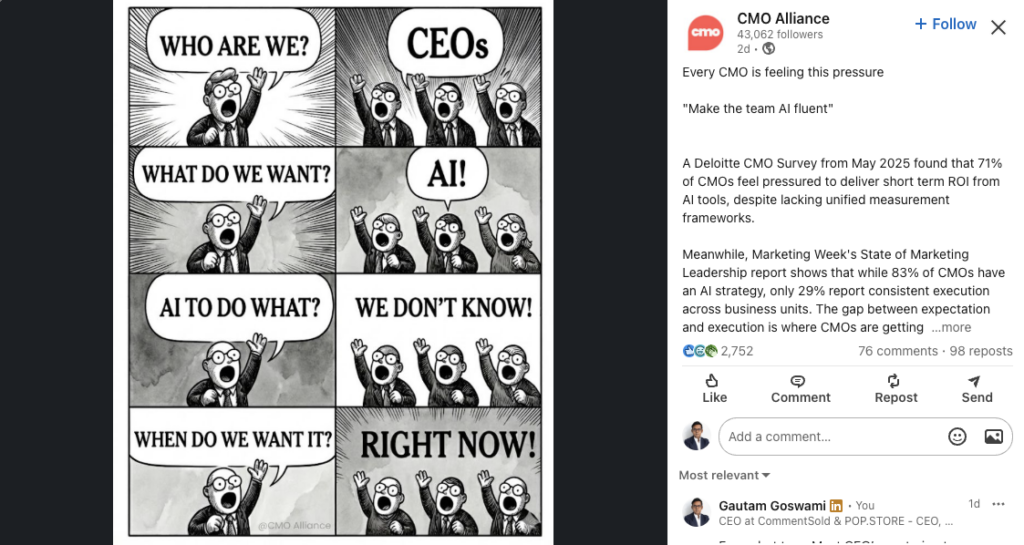
Most CEOs are operating under dangerous misconceptions: they all want to ‘get in’ on the AI trend, but not a lot of them know how to implement it to impact their company most effectively and immediately.
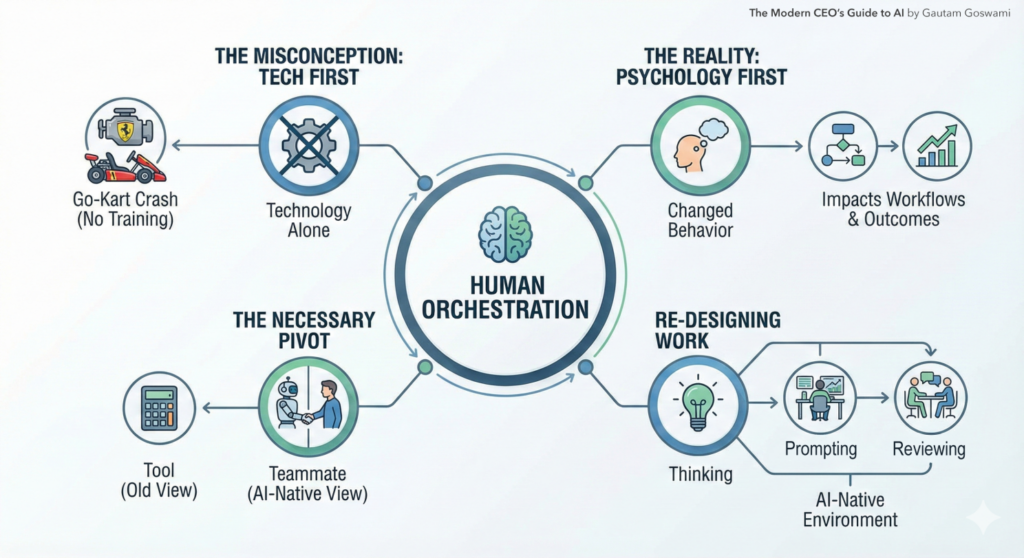
Many believe AI transformation starts with technology. In reality, it starts with psychology.
Technology changes capabilities, but only changed behavior can impact workflows and outcomes. If you drop a Ferrari engine into a go-kart without training the driver, you don’t get more speed—you get a crash.
Defining “Human Orchestration”
Human Orchestration is the discipline of redesigning how your employees think, work, and collaborate in an AI-native environment. It is the necessary pivot from viewing AI as a tool (like a calculator) to viewing AI as a teammate (like an intern, co-worker, or super-analyst).
“AI won’t replace people – but people who use AI will replace people who don’t.” Jensen Huang, CEO of NVIDIA
As we move into 2026, this shift is as seismic as the transition from paper to digital. It requires intention, education, and visible leadership from the top.
1. Redefining Work: From Output Creators to Output Directors
For the last century of industrial and knowledge work, employees were rewarded for production. The hours spent writing code, drafting memos, or calculating spreadsheets were the basic value metric.
In an AI-native company, the equation shifts:
- FROM: Creation through time and effort.
- TO: Production through efficient direction.
Your employees are no longer the bricklayers; they are the architects.
The “First Draft Principle”
Successful teams adopt a new workflow for creation:
- The Old Way: A junior analyst spends 20 hours researching and drafting a market report. A senior leader spends 30 minutes reviewing it.
- The AI Way: The analyst spends 30 minutes orchestrating an AI agent to generate the research and draft. The analyst then spends 2 hours fact-checking, refining strategic insights, and adding “human flavor.” The senior leader remains the final gatekeeper.
Real-World Example: The Evolution of the Dev Loop
Consider a software engineering team. A developer’s value has always been defined by the timely delivery of bug-free, functional projects. However, the method of achieving that quality is undergoing a fundamental shift.
- The Traditional Cycle (The “Maker” Mode): Historically, a developer spent the majority of their time in a manual loop: writing logic, creating unit tests, and painstakingly debugging errors line-by-line. The developer was the bottleneck for both creation and verification.
- The AI-Augmented Cycle (The “Orchestrator” Mode): With AI, the developer no longer writes the code; they orchestrate its creation. They utilize AI to generate the implementation and the automated test suites simultaneously.
- The Resulting Role Shift: Consequently, the developer’s worth shifts from manual execution to high-level architecture, prompt engineering, and rigorous oversight. They are no longer just laying bricks; they are the site foreman—defining the system constraints, instructing the workforce (prompting), and performing the final expert review.
2. The New Skill Map for Employees
You cannot simply give your team ChatGPT, Copilot, or Cursor and expect magic. Every employee, from Engineering to HR – needs a cognitive software update.
“We must stop training people for the jobs of the past and start training them for the skills of the future: curiosity, critical thinking, and the ability to ask the right questions.” – Ginni Rometty, Former CEO of IBM
The AI-Native Skill Map
- Problem Decomposition: The ability to break a complex business problem into small, logical steps an AI can execute.
- Prompt Architecture: Not just “asking questions,” but framing context, constraints, and formats to get high-quality output.
- The “BS Detector” (Critical Evaluation): AI hallucinates. It can be confidently wrong. Employees must move from trusting their own work to rigorously auditing the AI’s work.
- Workflow Redesign: The ability to look at a 10-step process and recognize that AI can combine steps 1 through 6 into a single autonomous action.
3. The Productivity Paradox (The “J-Curve” of Adoption)
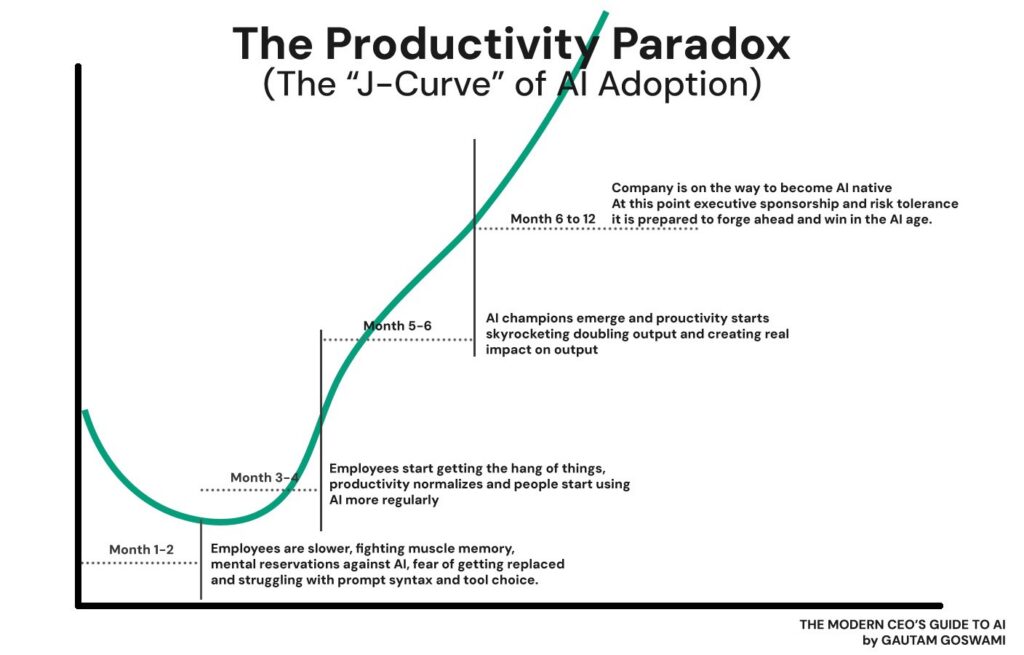
This is the point where most CEOs panic. In the first 90 days of aggressive AI adoption, productivity often dips. Expecting this to happen—and planning for it—will give you the power to push your organization over the hump.
This is the J-Curve of Transformation:
- Month 1-3: Employees are slower. They are fighting old muscle memory, double-checking the AI, and struggling with prompt syntax.
- Month 4-6: Parity is reached.
- Month 6+: Exponential acceleration occurs.
The CEO’s Role: You must articulate that the company is investing in the path, not just the immediate speed. If you punish the initial dip, employees will revert to old, safe, slow methods.
Example: A Marketing Team Integrates AI
Month 6+ (Acceleration): The constraints are gone. Instead of creating a single email blast, the team generates 50 hyper-personalized variations for different customer segments, A/B testing them simultaneously. Engagement rates double because focus shifts from “copywriting” to “campaign strategy.”
Month 1-3 (The Dip): Content production slows down. The team spends hours wrestling with prompts, only to receive generic, robotic output that requires heavy manual rewriting to sound “human.” The consensus is: “AI doesn’t get our brand.” Similarly, the design team struggles with low-value, obvious “AI-looking” imagery.
Month 4-6 (Parity): The team builds a custom “Brand Knowledge Base,” while the AI actively learns the business nuances through context. The team establishes a library of proven prompt templates. First-draft quality drastically improves, reducing editing time by half. Visual designers figure out the intricacies of prompting to generate results “better than Photoshop” in half the time.
4. The CEO as Chief AI Orchestrator
Whether you are a technical founder or a sales-led CEO, you cannot outsource the narrative. If the CEO doesn’t use AI, the company won’t either.
“The defining characteristic of the new era of leadership is not having all the answers, but knowing how to orchestrate the intelligence—both human and artificial—to find them.” – Satya Nadella, CEO of Microsoft
Your Personal Mandate
- Stop “Ghost-Writing”: Do not let your Comms team write your internal emails about AI. Use AI to draft them yourself, and explicitly tell your team you did so to model the behavior.
- Public Experimentation: During town halls, perform live demos—such as showing how you used AI to summarize the quarterly report. This visual proof normalizes usage.
- Vibe Code Yourself: If you are a product or engineering CEO, write code for a new feature yourself and demo it at the all-hands. You will inspire a surge of adoption that top-down mandates cannot replicate.
- Accountability: Change the question you ask your Department Heads. Instead of “What AI software are you using?”, ask: “How has your team changed their workflow this month?”
5. Building the AI-Native Culture
A company becomes AI-native when its culture rewards curiosity over consistency. In 2026, doing things “the way we’ve always done them” is a death spiral. You must create a “Safe-to-Fail” environment.
Cultural Pillars
- The “Prompt of the Week”: Create a Slack channel where employees share specific prompts that save them hours of work. Gamify the discovery of efficiency.
- No “Secret Cyborgs”: Many employees use AI secretly because they fear being seen as “lazy.” Flip the script: The lazy employee is the one not using AI to save the company time.
- Share the Wins (and the Hallucinations): Celebrate efficiency gains, but also laugh at AI failures. This reduces fear and helps the team understand the technology’s limits.
To turn philosophy into action, here is your checklist for the next 30 days:
🎓 1. Mandate “AI Fluency” Certification
Don’t just offer training; mandate it. Every employee must pass a basic certification on Data Safety, Prompting, and Output Evaluation. Treat this as seriously as cybersecurity training.
🏆 2. Identify and Elevate “AI Champions”
Find the 5-10 people in your org who are already obsessed with AI (often buried in middle management). Give them a title, a small budget, and a direct line to leadership to evangelize best practices.
🗣️ 3. Institutionalize the “Transformation Story”
At your next All-Hands, explicitly state: “We are not using AI to cut headcount. We are using AI to remove the boring work so you can do the work that gets you promoted.” You must win the narrative battle immediately.
The Tech Bite
A Tech Titbit to Tickle your Mind!
How TDD Becomes Ultra-Valuable in the AI-Coding Age:
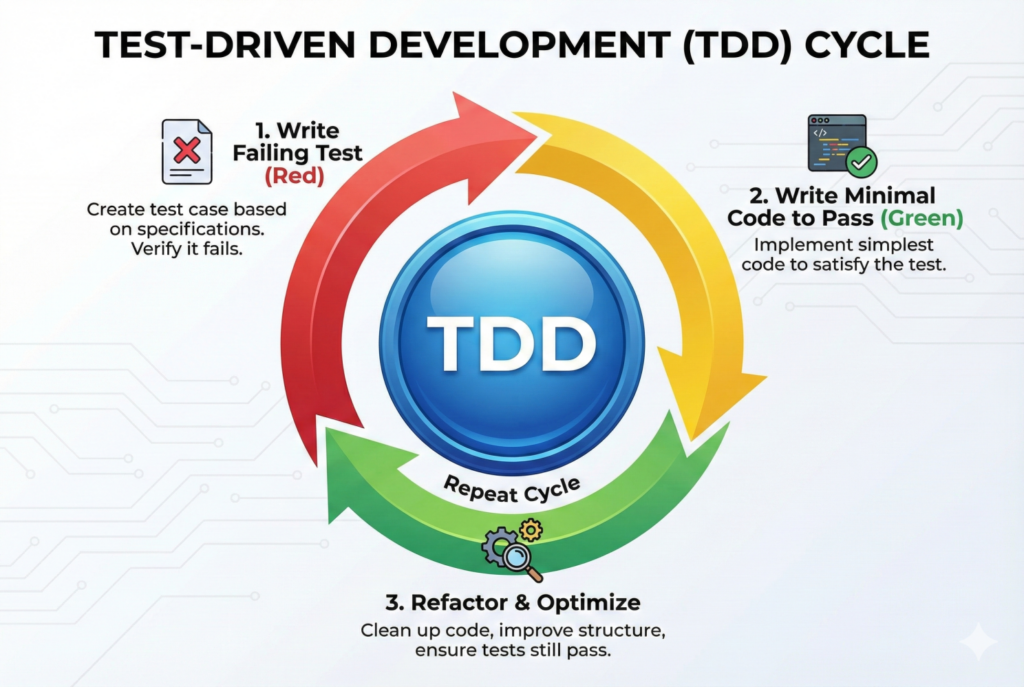
Test-Driven Development (TDD) is a software engineering practice that flips the traditional development process upside down. Instead of writing code and then testing it, you write the test first.

In the context of the "Architect & Verifier" role, TDD is the blueprint the architect hands to the builder. It defines exactly what the system must do before a single brick is laid.

The Core Loop: Red-Green-Refactor
🔴 Red (Write a Failing Test): You write a small automated test for a specific feature. It fails because the feature doesn't exist yet. Why: This defines the "definition of done."

🟢 Green (Make it Pass): You write the minimum code necessary to make the test pass. Why: This prevents over-engineering.

🔵 Refactor (Clean it Up): You improve the code structure without changing behavior. Why: You can clean up with confidence because the test ensures you didn't break anything.
Why AI Loves TDD (The New Superpower):
Historically, humans hated TDD because it felt slow (writing everything twice). But for AI, TDD is the specification language.

Tests as Prompts: Instead of a vague prompt, you write a specific test case. The AI now has a hard constraint. It cannot hallucinate or get creative; it must satisfy the test.

Instant Verification: Reviewing raw code is hard. Reviewing tests is easier. If the AI writes code that passes your tests (Green), your confidence skyrockets without reading every line of syntax.

The Shift: TDD stops being a chore and starts being the protocol you use to command and verify your AI workforce.
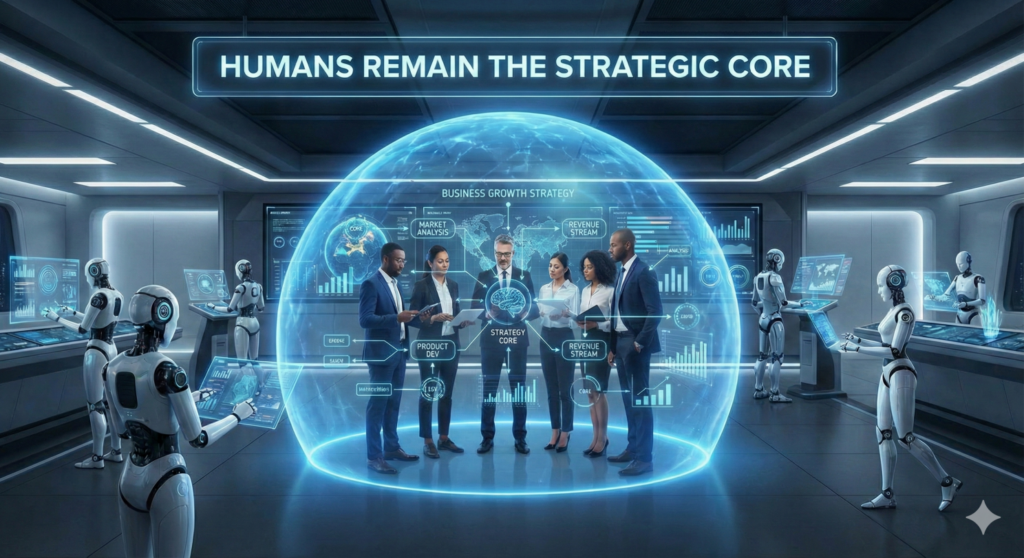
Final Thought: Humans Remain the Strategic Core
AI will change everything about how work gets done, but it will not replace the creativity, intuition, judgment, and leadership of human beings.
The companies that win in 2026 are not the ones with the most GPUs or the most data. They are the ones where the humans have stopped fearing the machine and have started orchestrating their tasks with it, as a valued co-worker.
Stay tuned for Chapter III, where I will deep dive into the steps of arming your tech team with the right AI toolset, to go from AI Assisted to AI Native in your engineering processes.
This article is chapter 2 of the series titled: The Modern CEO’s Guide to AI
Leave a Reply