
Introduction
I had the privilege of attending a pivotal gathering of CEOs on Sand Hill Road sponsored by Permira, a couple of weeks ago. In a room of leaders from some of the most consequential software companies in tech, we had the chance to hear from Munjal Shah – Founder and CEO of @Hippocratic.ai , Anton Osika, CEO and Co-founder of @Lovable, Kent Collier , CEAIO of @Octus and Alastair (Alex) Rampell , GP at Andreessen Horowitz
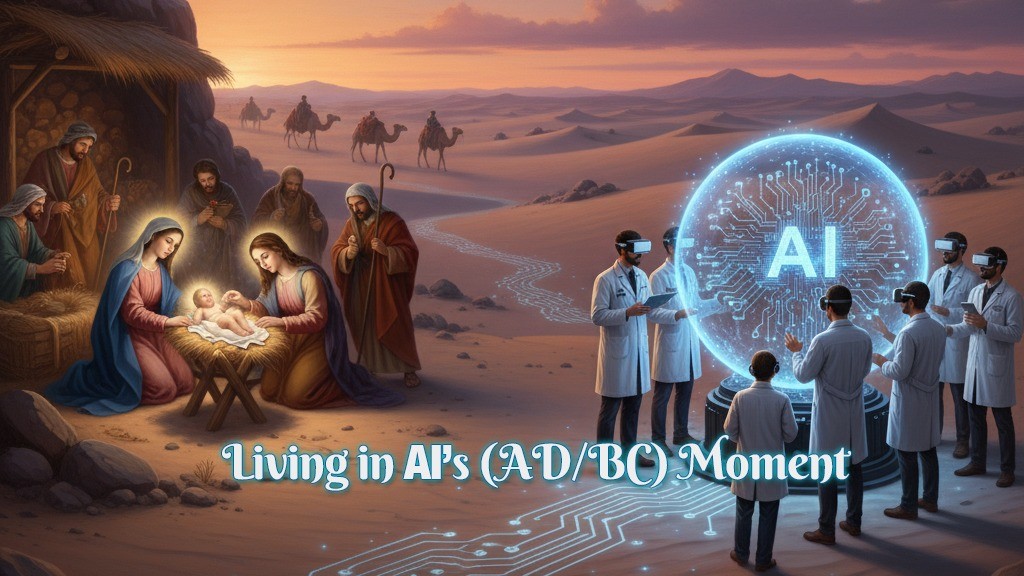
As the day unfolded, something became unmistakably clear: we are living at a historical inflection point. Artificial intelligence is now performing tasks that were science fiction not long ago. Just as the birth of Christ divided human history into “before” and “after,” the rise of AI is rewriting the boundaries of what machines can do – and what we can imagine.
God is basically ‘the all knowing, all powerful entity’ – and in building LLM models that have consumed pretty much all of known human knowledge, art and science – we are in fact building an artificial god.
This is our generation’s “A.D./B.C.” moment: the before and after of work, creativity, leadership, and innovation.
How Companies Are Embracing AI: Three Distinct Perspectives
As we navigate this shift, companies view AI through radically different lenses – three distinct mindsets in a modern gold rush.
1. The Legacy Enterprises
These are the seasoned miners working the same claim for decades. They’re not searching for new gold veins – they’re trying to use AI to squeeze more out of what already exists. Even a 15% productivity bump at their scale is monumental. For them, AI is a process optimizer, not a reinvention. It’s about tuning the machine, not rebuilding it. They are also spending a ton of money with consulting firms and buying Cursor licenses for their massive development teams, but not really doing much with it yet.
2. The Cloud-Native Companies
Then come the agile prospectors – cloud-native companies born in the past decade. Built on modern infrastructure, they are treating AI as leverage. They’re flattening organizational structures, accelerating development cycles, and asking hard questions: Why have 1,000 developers when 250 plus AI can ship faster? For them, AI isn’t an enhancement – it’s a competitive accelerant. Many are even rethinking their own business models and disrupting from within to avoid being disrupted by the next category.
3. The A.D. Companies (AI Native)
Finally, we have the companies that exist because AI exists – the true A.D. innovators. They see AI not as a tool but as the foundation. Their products aren’t traditional software with forms and fields. They are living, conversational, agentic systems that understand, react, interpret, self-correct, and deliver outcomes. These are the companies that will redefine entire industries because they are unconstrained by legacy and shaped entirely by a new reality.
There is no polite way to say it: AI-native companies will upend every industry. Their advantage isn’t incremental – it is foundational.
The Human Impact: How AI Is Rewriting the Rules of Work and Life
As AI reshapes industries, the shift is not just operational – it is emotional, psychological, and deeply human. The story of AI is as much about our hopes and fears as it is about algorithms.
Adapting to New Tools
For workers, AI is becoming a collaborator. That’s exhilarating – and terrifying. Automation frees us from drudgery but forces us to confront a new question: Where do humans now add the most value? The opportunity lies in using AI as a creative multiplier, not a replacement. Our irreplaceable strengths – empathy, creativity, judgment – become more important, not less.
The CEO as the Chief AI Officer
Leadership itself is being rewritten. CEOs can no longer delegate AI strategy downward – they must own it. The modern CEO must effectively serve as the Chief AI Officer, driving adoption across every department and ensuring intelligence (human and artificial) flows through every part of the company.
Executives who embrace this responsibility will define the next category-leading businesses. Those who do not will be replaced – not by AI, but by CEOs who understand it.
A Broader Societal Shift
Beyond companies, AI is reshaping culture and society. It brings genuine fear – job loss, surveillance, misinformation – and genuine hope: breakthroughs in healthcare, education, climate, creativity. It also brings new threats, including cyber-attacks so intelligent they will overwhelm today’s security systems.
Humanity is entering a transformation so profound that it’s twisting even the sharpest business minds into Laugenbrezels.
Personal Impact: How I Am Trying to Adapt
Ironically, the most significant AI progress inside our own companies happened after my designated Chief AI Officer left. Not because he wasn’t capable – but because AI transformation cannot be outsourced. The CEO must lead it.
Once that became clear, I made a hard decision: pause every project, rebuild our development stack on a Cursor–Claude workflow, and redesign every interface from the last six months into an AI‑first experience. Only then did we begin shipping features that felt truly competitive.
When Munjal Shah played a recording from Hippocratic.ai – a conversational agent handling a patient phone call – it was a personal turning point. I realized something: in AI‑powered conversational systems, 95% accuracy isn’t good enough. Consumers compare AI directly to human intelligence, speech, and emotional intuition. And because AI has no innate EQ, we must design it in.
The next few months will be difficult, but I’m committed to instilling this mindset across every department at CommentSold and POP.STORE so we can compete – truly – in the AI A.D. era.
Conclusion
We are living through the dividing line of history – a moment future generations will study alongside the Industrial Revolution and the birth of the Internet. How we build, how we lead, and how we adapt will define the next era of humanity.
This is the dawn of the AI era. The question isn’t whether we cross the threshold – it’s how we choose to walk through it.

Leave a Reply